

Introduction: Why So Many Builders Are Missing Out on Ready-to-Buy Customers
Most small and mid-sized builders and remodelers work hard to get people to their websites. You spend money on Google, Facebook, Instagram, maybe even YouTube. You post photos of your builds. You update your site. You try to make sure people can find you.
But there’s a simple truth almost no one talks about:
Many of your best buyers never become leads. They visit your website… then leave.
They never call.
They never fill out a form.
They never book a consultation.
This is Invisible Buyer Loss.
You don’t see the loss because it never enters your CRM and never results in form fills or phone calls. You don’t even know those buyers existed.
And for builders and remodelers who are already investing in traffic — this is the biggest hidden leak in your sales funnel.
This article breaks down:
- What invisible buyer loss is
- Why modern buyers behave this way
- Why most builder websites convert below 1% (but should be 3% or higher)
- How small changes in clarity and interaction can unlock more high-quality leads
- Simple steps builders can take today to regain lost buyers
No products to buy.
No tech requirements.
Just straight education and practical advice for builders who want more lead flow from the traffic they’re already paying for.

What Is Invisible Buyer Loss?
Invisible buyer loss happens when website visitors leave without becoming leads, even though they were real potential customers.
You don’t see this problem because:
- They never filled out a form
- They never called
- They never talked to your team
- They never booked an appointment
So the loss is invisible.
But the impact is real.
And the biggest shock for builders is this:
Invisible buyer loss often affects your most motivated buyers — the ones closest to making a decision.
Why?
Because these are the buyers with the most detailed questions.
And if they can’t get clarity quickly, they simply move on to the next builder.
Why Invisible Buyer Loss Is Growing Faster Than Ever
Homes and remodels are big decisions. People used to make those decisions in showrooms or on the phone. Today, they make them on your website (usually on their phone) and often outside business hours.
Here’s what today’s buyer looks like:
1. They shop after-hours
Most builder websites see their highest traffic between 7pm and 10pm.
Most teams are offline.
2. They want quick clarity
People want answers to basic questions right away:
- What does this cost?
- What’s included?
- Do you build in my area?
- What’s the timeline?
- Can I customize the plan?
If they can’t get clarity without digging through pages, they bounce.
3. They hesitate to call or fill out a form
Buyers don’t want sales pressure early in their journey.
They want information first.
A surprising number of buyers say they avoid:
- Phone calls
- Contact forms
- “Request a quote” buttons
- Anything that feels like commitment
4. Mobile attention spans are short
If a buyer can’t figure out where to click in 10–15 seconds, they move on.
Not because they’re not interested.
Because the friction is too high.
The Market Data No One Tells Builders
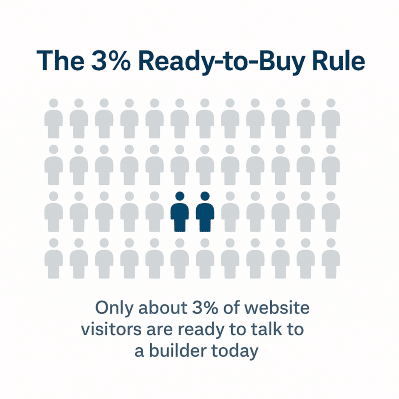
Across industries, the average “ready to buy” rate is about 3% of all website visitors.
Meaning:
Out of every 100 visitors, around 3 are ready to talk to a builder today.
Yet most builder and remodeler websites convert below 1%. Some convert below 0.5%.
That means for every 100 real buyers who show up…
you’re only capturing a fraction of one.
The others disappear forever = invisible buyer loss.
Here’s the part that matters most for builders:
If you’re spending money on digital marketing, but converting only 0.5%–1% of your traffic, you’re not seeing the return you should. You aren’t maximizing the traffic you’ve already paid for.
Where Builders Lose Buyers on Their Websites
After reviewing over 300 builder and remodeler websites, the same patterns show up again and again. Below are the top areas where invisible buyer loss happens.
1. Pricing is unclear or hidden
The #1 question buyers have is “What does this cost?”
Yet many sites make buyers dig… and dig… and dig.
If buyers can’t find even a range, most leave.
2. No instant way to get answers
Builders often rely only on:
- Contact forms
- Phone numbers
- “Book a consultation” buttons
But these all require commitment the buyer isn’t ready for.
Most buyers want to “ask a quick question” first.
If they can’t, they bounce.
3. No path for mobile users
Many builder sites look great on desktop… but get confusing on mobile.
Common issues:
- Menus too small
- Buttons too close together
- Hard to find floor plans
- Slow loading pages
Since most traffic is mobile, this creates major drop-off.
4. Too much text, not enough clarity
Many websites overwhelm buyers with paragraphs of information when buyers only want:
- Cost
- Availability
- Process
- Timeline
- Areas served
Clear > clever.
5. No after-hours coverage
Most visitors show up when offices are closed.
If you offer no way for them to get answers outside 9-5, you lose buyers without ever knowing it.

The 4 Buyer Moments That Make or Break Your Conversion Rate
Every builder website has four critical “moments” that determine if a buyer becomes a lead or becomes invisible buyer loss.
Moment 1: The first 10 seconds
The buyer decides instantly:
- “Do they build what I want?”
- “Do they build where I live?”
- “Is this worth my time?”
If your homepage doesn’t answer those clearly, they leave.
Moment 2: The search for pricing
Buyers will give you 20–30 seconds to find pricing.
If they fail, they leave.
This is why even a simple “Projects start at $X” or “Most remodels fall between $X–$Y” keeps buyers engaged longer.
Moment 3: Getting answers to one personal question
This is where most buyers drop.
If a visitor has one specific question, even small, and can’t get an answer quickly, they won’t convert.
Examples:
- “Do you remove load-bearing walls?”
- “Can I bring my own architect?”
- “Is landscaping included?”
The buyer who asks these questions is almost always serious.
Moment 4: The next step feels too heavy
Many builders ask for too much too early:
- Long forms
- Full contact info
- “Book a consultation”
- “Schedule a design appointment”
Buyers don’t want a commitment until they feel confident.
If your next step feels too big, they disappear.
How to Fix Invisible Buyer Loss Without Changing Your Whole Website
Below are simple, builder-friendly improvements that do NOT require total redesigns.
These are practical upgrades any builder or remodeler can implement.
1. Add simple, honest pricing clarity
Not a full price list.
Just a starting price or range.
Examples:
- “Kitchen remodels typically range from $35k–$80k.”
- “Custom homes start in the mid-$600s.”
- “Most additions fall between $140–250 per square foot.”
Buyers don’t need exact numbers.
They need to know whether you’re in the right ballpark.
2. Add a simple “Questions? Ask now.” interaction point
Allow buyers to get quick clarity, even if it’s after hours.
This could be:
- A simple chat box
- A dedicated “Quick Answers” page
- A guided FAQ flow
- A short “Help me choose” form
The point is to lower friction.
Make it easy to ask on their terms, before talking to a salesperson.
3. Rewrite key pages for clarity, not marketing
Rewrite pages so buyers can find what matters in seconds.
Focus on:
- What you build
- Where you build
- Starting prices
- Timeline
- Process
- What’s included
This helps both human buyers AND Google.
4. Create a fast “Start Here” page
This page should answer:
- Who you are
- What you build
- Your starting prices
- Your build/remodel process
- How long projects take
- A simple next step
This one page alone often lifts conversion rates 20–40%.
5. Improve mobile UX
Make sure:
- Buttons are large
- The menu is simple
- Each page loads fast
- Floor plans and galleries are easy to open
Mobile users are your main audience now.
6. Offer a lighter “micro-step” before a full consultation
Examples:
- “Get a quick estimate”
- “Check your build area”
- “See if we’re a fit”
These micro-steps ease buyers into the process instead of pushing too fast.
Why This Matters: The Math of Small Conversion Wins
Let’s look at a simple example.
If your website gets 2,000 visitors a month, here’s what happens at different conversion rates:
At 0.5% conversion
→ 10 leads/month
At 1.0% conversion
→ 20 leads/month
→ +10 more leads (without buying more traffic)
At 2.0% conversion
→ 40 leads/month
→ +30 more leads
At 3.0% conversion (market benchmark for “ready to buy”)
→ 60 leads/month
→ +50 more leads
This is why invisible buyer loss matters more for builders who already invest in digital marketing.
Traffic isn’t the issue.
Conversion is.
What This Means for Builder Owners and Remodelers
You don’t need more traffic.
You need to capture the buyers who already show up.
Invisible buyer loss is happening on almost every builder’s site, even well-designed ones, simply because buyers today behave differently and want rapid clarity.
The builders who fix this early will:
- Capture more serious buyers
- Lower their cost per lead
- Raise their close rate
- Grow faster without increasing ad spend
This is the next big frontier of digital marketing for builders.
Conclusion: Your Website Should Be Working as Hard as You Do
You work hard to deliver great builds.
You work hard to create happy clients.
You invest real money to bring people to your website.
The last thing you want is to lose serious buyers simply because they couldn’t get answers fast enough.
The good news is this:
The fixes are simple.
The gains are real.
And the builders who take this seriously now will win market share over the coming years.