

The financial success of any business is based on one thing: money coming in should exceed money going out. In the world of residential construction, that means looking in depth at all your costs and what to charge your customer.
But this is often easier said than done.
Between fluctuating material prices and changing scopes, getting costs right isn’t just about accuracy upfront. It’s about having a costing process that holds up as the build moves forward. And if you’re not on top of this, you could be left undercharging your client and taking the financial brunt.
This guide for residential builders breaks down how building costing actually works, where things can go wrong, and how you can create faster, more reliable costings without drowning in spreadsheets.
What Is Building Costing?
Building costing is about what the project actually costs, not what you thought it would cost.
It happens during and after construction and deals with actual spend versus estimates. The goal is to compare budgeted costs to actual costs, control overruns, and understand the project’s final profitability.
Typical costing activities:
- Managing change orders and cost overruns
- Recording invoices and dealer bills
- Labor cost tracking
- Change order costing
- Job cost reports
Building costing vs estimating: what builders often get wrong
They sound very similar, and people use them interchangeably. But costing and estimating are not the same thing.
These terms show the difference between pricing a job and managing costs through the build. Estimates might look right, but you could still lose money.
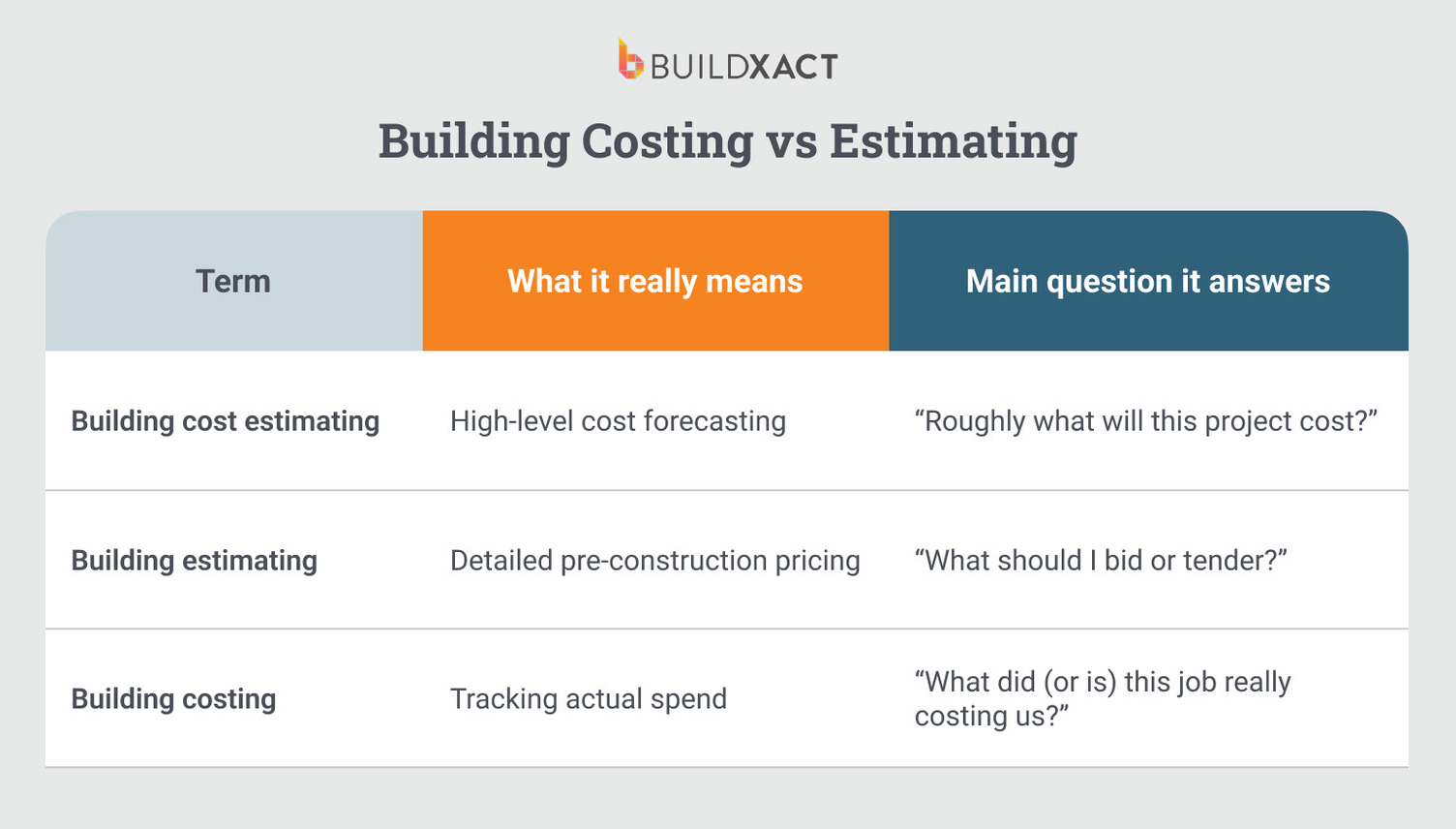
Building estimating is where things get specific. It’s the process of breaking a project down line by line to determine exactly what it will cost to build, based on drawings, specs, and quantities. It usually happens once all drawings and specs have been developed.
Typical estimating activities:
- Creating detailed quantities and takeoffs
- Dealer pricing and bids
- Producing a tender price or client bid
Cost estimating is the big-picture, early-stage forecasting that creates a strategic view of financial resources on a project. It focuses on predicting what a project is likely to cost before everything is fully designed or priced. It’s often done early, when there are still unknowns like materials prices and market conditions.
Costing estimating activities:
- Forecasting total project cost
- Comparing design options or scope changes
- Answering: “Is this project financially viable?”
Why Is Building Costing Important?
It’s crucial to do a cost estimation for every construction project you undertake, whether you are part of a large company or a small business. Without a construction cost estimate, a project budget can be underfunded, or time expectations could be understated.
Construction cost calculators are tools that introduce more accountability, create more transparency, and build trust when your building estimate is on point. Ultimately, it’s about saving money and getting your construction jobs done on time.
Building costing is what keeps a job profitable once construction starts. An estimate might win the project, but costing is what tells you whether you’re actually making money as the build progresses. Without clear costing controls, factors such as rising material prices, slipping timelines, and client changes can push a job over budget.
Good building costing means tracking real costs as they happen and comparing them to your original budget. That way, if something starts drifting off track, you can fix it before it becomes a major problem.
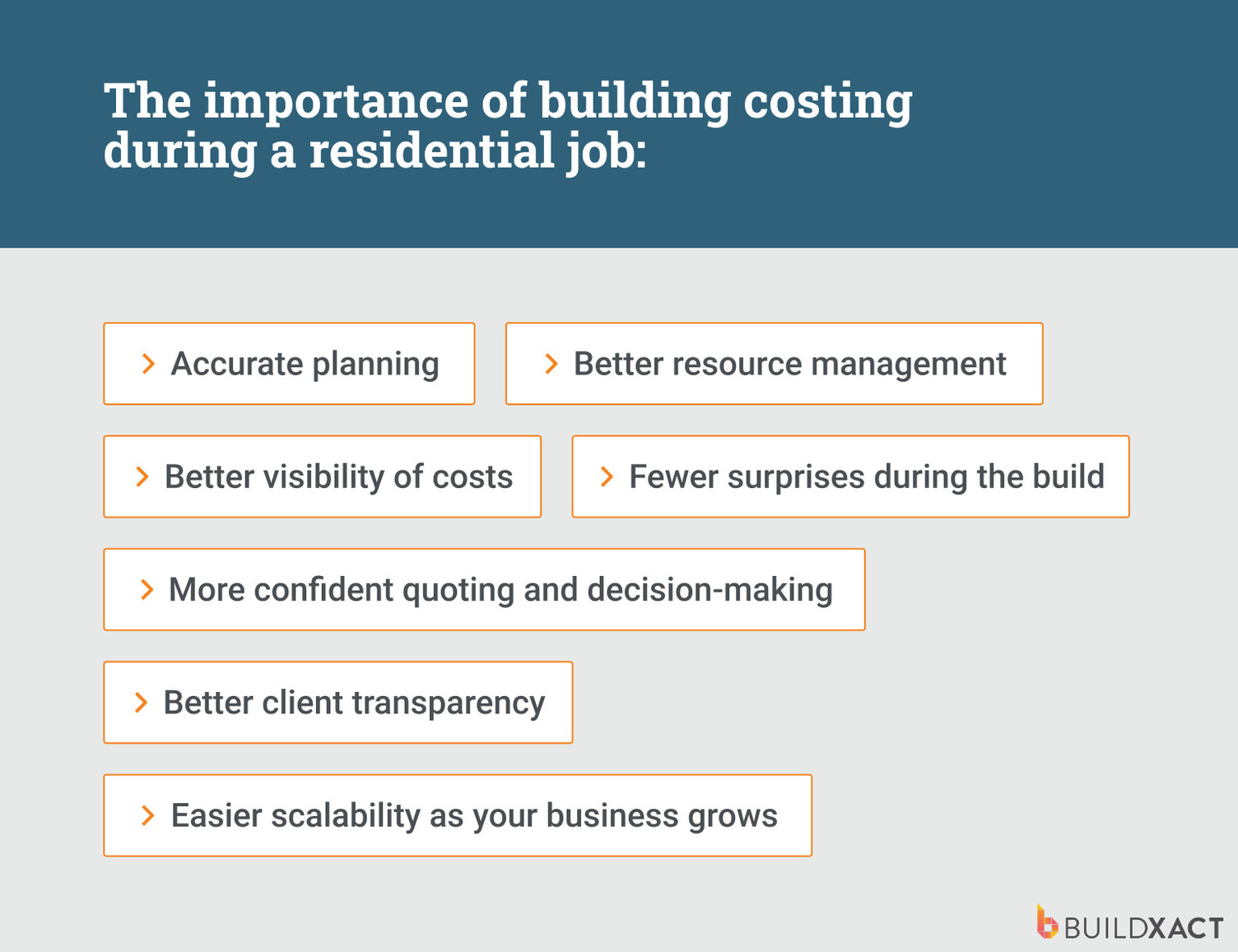
Accurate planning
An estimate gives you the starting number, but building costing tells you whether that number still makes sense once construction begins.
As the build progresses, real-world factors start creeping in, such as weather delays, site surprises, and dealer changes. Good costing keeps you grounded in reality by tracking what the job is actually costing as it unfolds, so you can adjust before small issues turn into expensive ones.
Better resource management
When you’re actively tracking labor, materials, and subcontractor spend, it becomes much easier to keep the job running smoothly. You can spot when costs are drifting and make adjustments before inefficiencies slow down the whole project.
Instead of guessing where the money is going, you’re working with real numbers that help you keep crews productive and the schedule moving.
Better visibility of costs
Once you calculate the cost of building a home, you can see the feasibility of your construction project. Is your client’s budget going to cover the costs needed to build their house? Are there any cost differences that can alter your profit margin? Better cost visibility leads to better value and fewer surprises down the road.
When Should Building Costing Happen During a Project?
This is a bit of a trick question because building costing doesn’t happen at just one point in a project. An initial cost check usually occurs early in the pre-design stage, followed by a more detailed costing once plans and specifications are developed.
Costing should be reviewed regularly throughout the design and construction process. Any time the design changes or the scope shifts, the numbers should be revisited. The more you keep your construction cost calculator crunching the numbers, the more accurate your final numbers will be.
How Long Should Building Costing Take?
Again, this is a question that doesn’t have a simple answer. The most time-consuming part of the building cost process is the material quantity takeoff.
A precise, detailed takeoff is the backbone of an accurate cost estimate, but doing the entire process by hand will take considerable time, skill, and industry knowledge. However, if you use Buildxact’s estimating software, you can get back about 80% of the time you’d usually spend on the construction estimating process.
What to Include In Your Building Costs
Everything that will cost money on a construction job or house build must be included in your building costing. Whether they are direct or indirect costs, they will affect your bottom line if you don’t account for them in your bids.
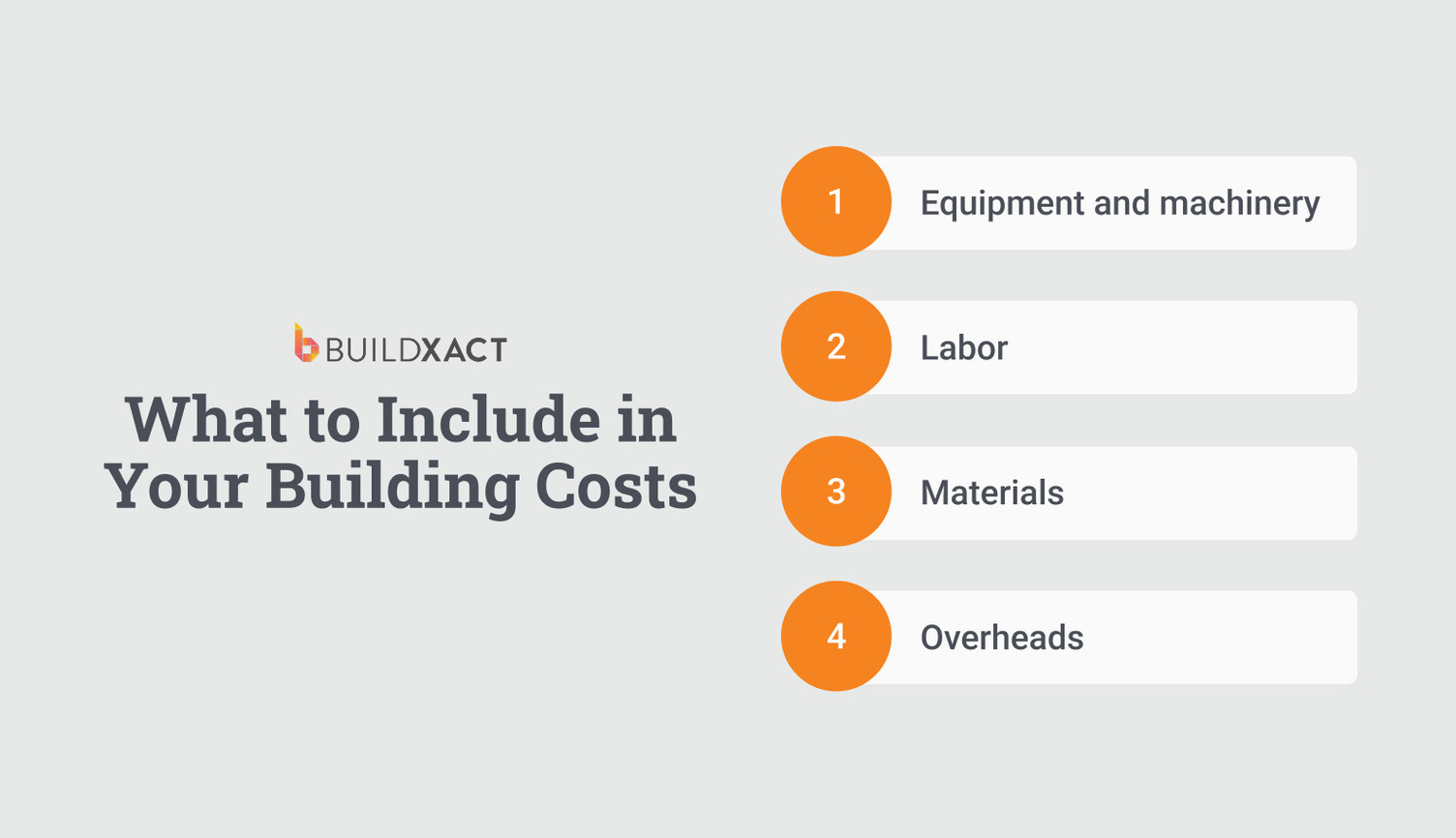
Equipment and machinery
In this category, you must include the costs of tools and equipment hire, as well as the costs associated with running machinery, equipment, and work vehicles. Another often-forgotten aspect is the logistics and costs of transporting machinery and equipment to the worksite. If the equipment stays on-site, securing it may also be a direct cost you have to account for.
Labor
To complete your project, you will need a workforce. Adding labor to your building costing is crucial, but you also have to consider contractors’ and tradies’ costs. Some of your labor costs may be determined by the price per job or by the cost per hour. In this case, you need a timeline estimate to get an accurate labor cost. Luckily, our building cost calculator software can do that for you.
Materials
By conducting a quantity takeoff, you can estimate material costs, but you also need to include other costs. You have to consider delivery costs, moving materials, price increases, and whether you need to allow time to make any adjustments to anything your building project will use.
Overheads
These are the behind-the-scenes costs that keep your business running, and they’re easy to forget when pricing a job. Office rent, insurance, taxes, utilities, and maintenance all need to be covered somewhere. If you don’t include them, your profit margin goes down.
The Costing Process For a Residential Job
Building costing isn’t something you do once and forget about. It’s an ongoing process that starts early and continues right through to the final invoice. It can take a long time to complete the costing process, and if you want it to be accurate, it must be thorough.
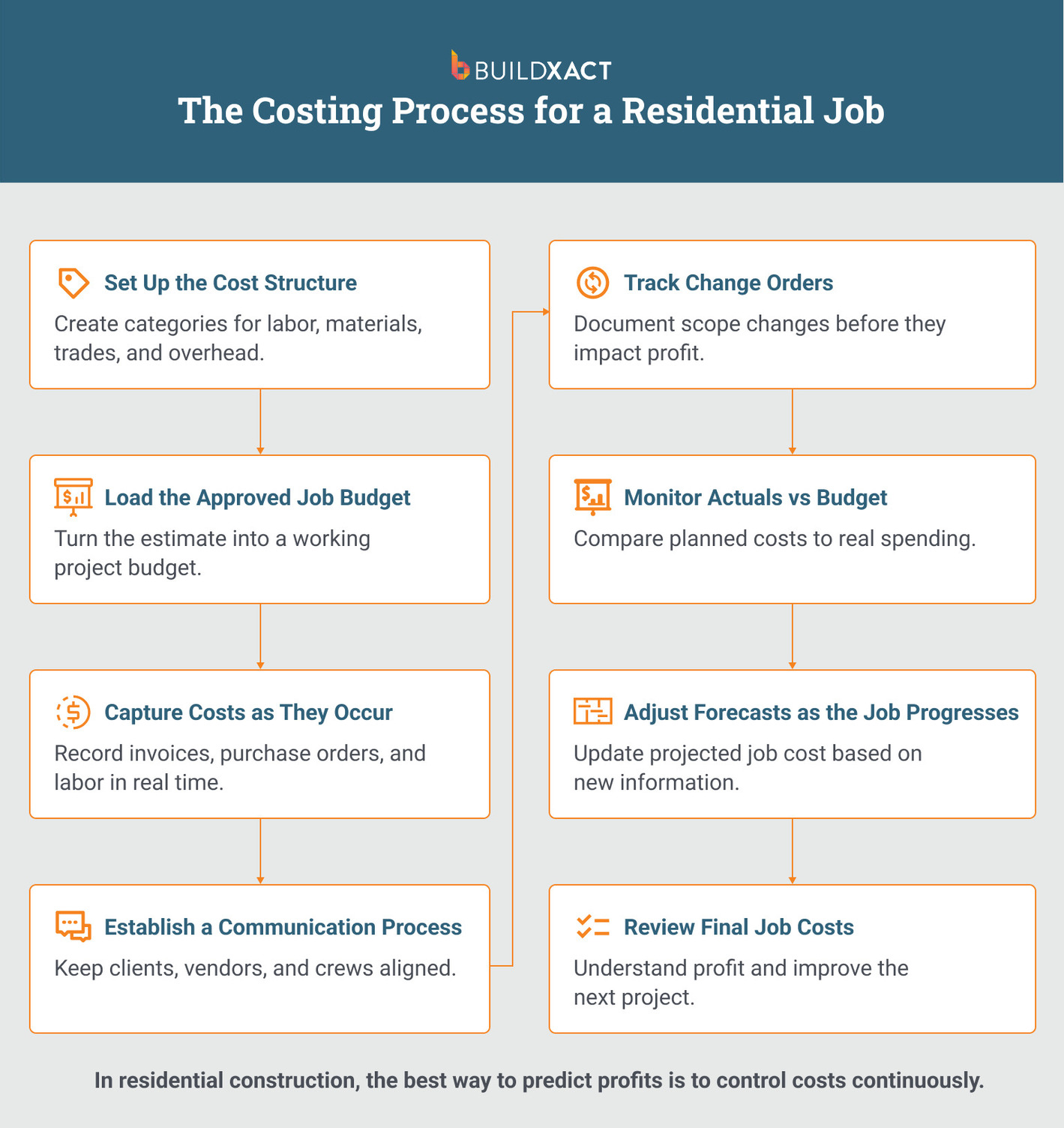
1. Set up the cost structure
Every job should begin with a clear cost structure that separates labor, materials, subcontractors, site costs, equipment, and overheads.
This structure becomes the backbone of your project costing. When categories are consistent from job to job, it’s much easier to track spending, compare projects, and identify where costs are creeping up.
With Buildxact, you can create structured cost categories within your estimates and automatically carry those through to the job budget. Once the project begins, you can log every purchase order, billing record, and subcontractor cost against the correct category, making it easy to see exactly where the money is going in real time.
2. Load the approved job budget
Once a bid is accepted, the estimate effectively becomes the project’s starting budget. This approved budget is what you measure everything against throughout the build.
Loading the job budget into your costing system creates a clear financial baseline. From that point on, every cost recorded on the project can be compared to what was originally planned.
One advantage of Buildxact’s connected workflow is that estimates can be converted directly into jobs without re-entering data. Builders can move from estimating to project management in one step, ensuring the approved budget flows directly into the costing process.
3. Capture costs as they occur
Once construction begins, the focus shifts to tracking actual spend. Materials are purchased, subcontractors submit invoices, and site costs begin to accumulate.
If these costs aren’t captured regularly, it becomes difficult to see how the job is really performing financially. Waiting until the end of the project to review spending often means problems are discovered too late.
With Buildxact’s cost-tracking tools, you can log purchase orders, dealer invoices, and subcontractor costs directly against the job as they occur. This provides a live view of project costs and helps ensure nothing slips through the cracks.
4. Establish a communication process
The next step is to set up an efficient communication system to contact contractors, dealers, and engineers, so that they can clearly see their job allocations and schedules. Our project management and construction estimating software can help you with this.
In Buildxact, you can schedule work, send task notifications to subcontractors, and keep everyone updated on timelines from a single platform. Bulk scheduling emails and automated reminders make it easier to keep trades aligned with the project schedule.
5. Track change orders
Clients request upgrades, site conditions reveal surprises, or design changes occur mid-project. These change orders can significantly affect the project budget if they’re not recorded properly.
That’s why every change should be formally tracked and costed. Keeping change orders separate from the original job budget provides clear visibility into how project costs evolve.
Buildxact’s change order and client portal features make this process easier by centralising change orders and allowing clients to review and approve changes quickly, helping projects move forward without confusion or delays.
6. Monitor actuals versus budget
This is where costing becomes a powerful decision-making tool. By regularly comparing actual costs against the approved job budget, builders can see whether the project is tracking as expected or starting to drift off course.
If labor hours exceed expectations or material costs spike unexpectedly, those issues can be identified early, while there’s still time to respond.
Buildxact provides real-time cost-tracking dashboards that let builders view job performance by cost category, project, or item, helping them stay on top of profitability throughout the build.
7. Adjust forecasts as the job progresses
As real costs come in, you should continuously update your forecast for the final job cost. If certain costs are trending higher than expected, you can make adjustments elsewhere in the project to keep the overall budget under control.
Because Buildxact links estimates, job budgets, scheduling, and cost tracking, builders can update forecasts based on real project data rather than guesswork. This creates a clearer picture of where the job is financially headed.
8. Review final job costs
Once the project is complete, the final step is reviewing how the job performed financially.
Comparing the final job cost to the original budget provides valuable insights. Builders can identify which areas stayed on track, where costs ran higher than expected, and what lessons can be applied to the next project.
Over time, this feedback loop helps refine pricing, improve future estimates, and strengthen overall profitability.
Because Buildxact keeps job data, costs, schedules, and invoices in one platform, you have a complete project record to analyze performance and improve future costing accuracy.
Common Mistakes to Avoid When Building Costing
It is easy to lose money or jobs if your cost estimating isn’t accurate. There are some common mistakes that you should avoid when calculating your costs.
Underestimating labor costs
As a major expense, labor costs must be calculated correctly, or your budget will balloon out quickly. The only way to ensure you calculate labor costs correctly is to accurately estimate the timeline of your building project.
If your project runs six months over, that’s likely six months of labor you haven’t accounted for, throwing your budget way off. Plus, you may need to factor in pay rises if your project is going to take a long time to complete.
Not factoring in risks
If you don’t account for factors like bad weather when producing a construction cost estimate, you’ll end up over budget. If there’s any incident likely to stop or slow construction, you need to factor that risk in. Delays cost money, but if you’ve accounted for them in your estimates, you’ll stay on track.
Relying on outdated pricing
Material and labor costs change constantly. Using old price lists or last year’s job data can lead to serious underestimates, especially in volatile markets. You can check prices against current dealer bids and recent jobs using Buildxact’s dealer connection tools.
Leaving out costs
Before you can make a profit, you must cover all your costs. So, when you leave out items like utility bills and office maintenance from your cost estimates, your profit margin will suffer. Make sure you include every direct or indirect cost in your estimation.
Underestimating timelines
Longer builds increase site costs, supervision, equipment hire, and overheads. If the schedule is too optimistic, the final cost will almost always blow out.
Tools to Improve Construction Costing
There’s only one way to improve your business’s cost estimating: with fast, accurate, and easy-to-master building cost estimator software. With Buildxact, you’ll have a quantity takeoff produced, a cost estimate compiled, a bid written, and all sent in about 80% less time than it used to take.
And once the project kicks off, the same system keeps working for you. Costs can be tracked as they occur, purchase orders sent to dealers, and change orders recorded as they arise. Instead of trying to piece together the financial picture at the end of the job, you can see how the project is tracking every step of the way.
Start your free Buildxact trial today and experience a faster, simpler way to manage building costing.