
While estimating construction project costs is familiar to many, putting together a project schedule in a logical way can be more difficult. To get it right, you must predict how long each task will take, put them in the correct order, and link each task properly so one flows into the next within your build timeline.
But creating a schedule isn’t enough. In addition to an easy-to-read timeline, you need to track time on site and compare it to your schedule. This is how you can spot delays early and make adjustments before they snowball into bigger problems.
In this article, we’ll walk through how to estimate construction time more accurately, track it during the build, and use that data to stay in control as your business grows.
Understanding Construction Time in Residential Projects
Time management in residential construction is very different from running a large commercial site with layers of project managers and rigid systems.
On a home build or renovation, things are more fluid. Crews are smaller, subcontractors rotate between jobs, and clients are often more involved. That makes construction time more hands-on and shaped by what happens on site each day. And if you’re the sole owner, it’s usually all on you.
The pressure to use your time well is even greater because time equals money. Every extra day on site means more labor, more overhead, and tighter margins. If you want accurate job cost estimates, you need a clear handle on the project timeline and keeping it accurate from estimate to completion.
But time management is about more than putting start and finish dates on a construction timeline. It’s not just a bar chart with good intentions. Real construction time management also involves:
- Estimating task durations
- Sequencing activities correctly
- Tracking real progress
- Updating forecasts
- Protecting the critical path
- Adjusting when conditions change
Get your time right, and you keep control of your projects. Keep control of your projects, and your business can grow smoothly and confidently.
Why Accurate Construction Time Estimation Matters
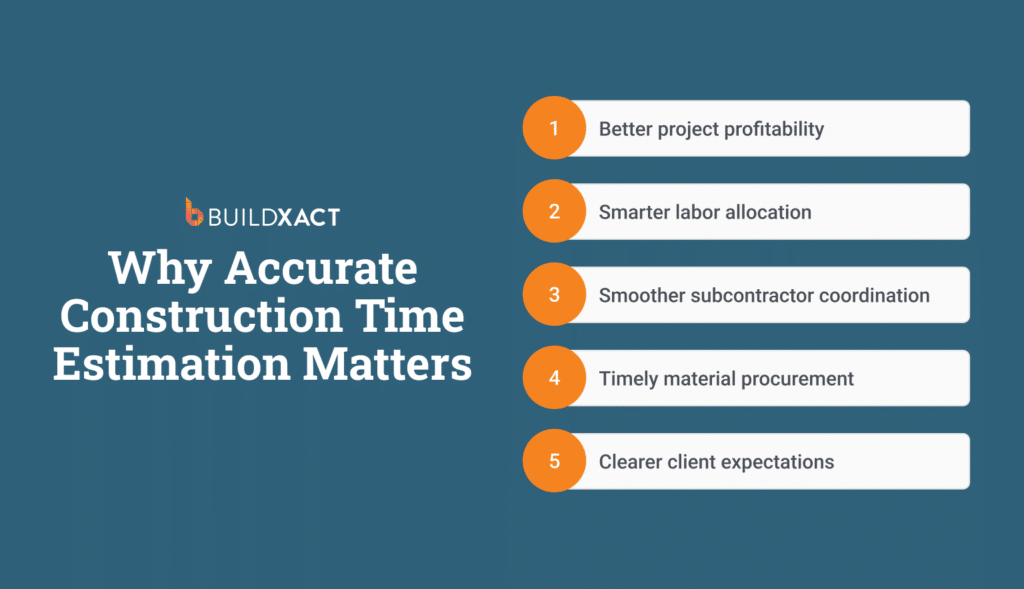
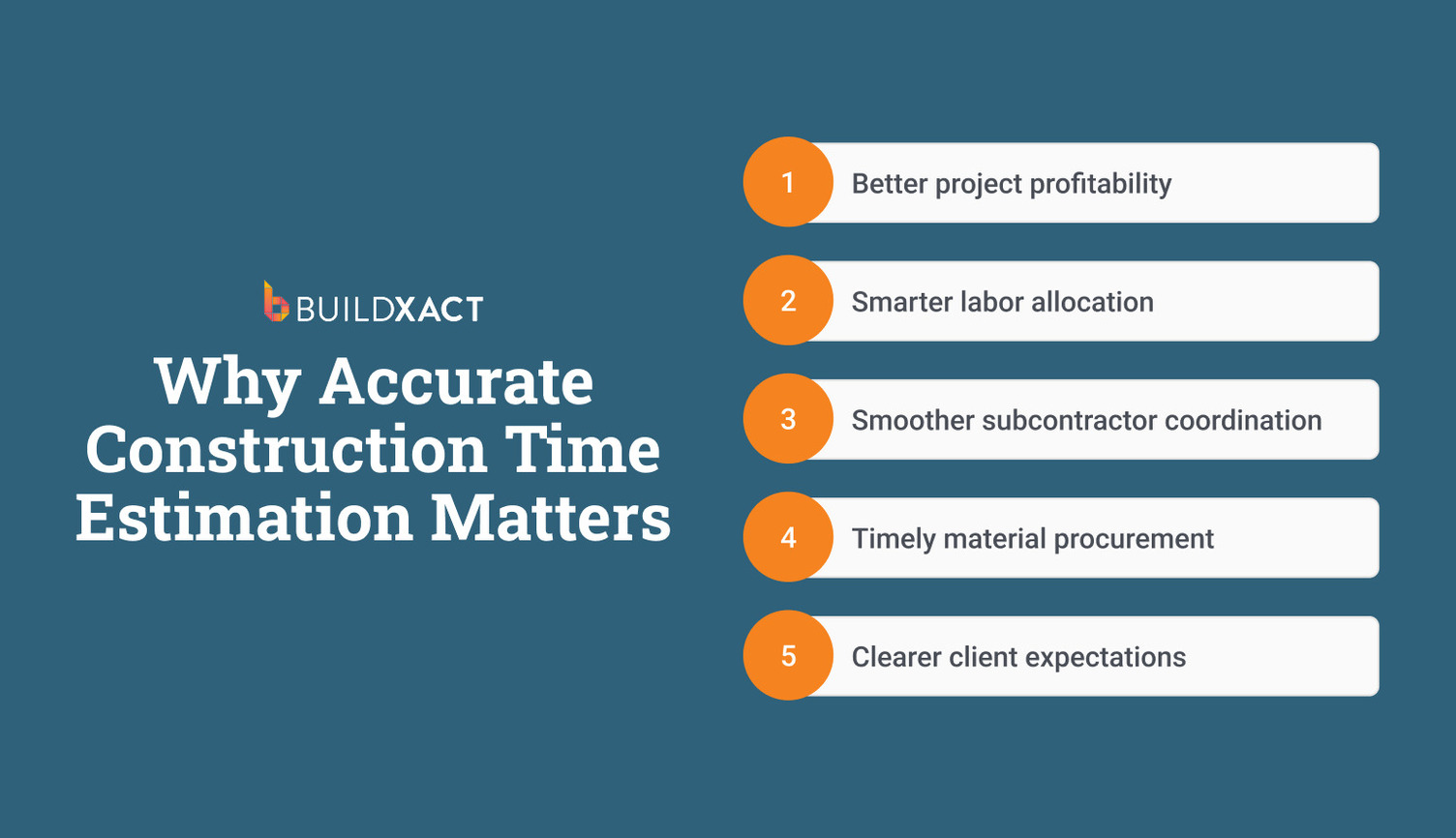
Accurate construction time estimation sits at the center of successful residential builds. It influences profit, trade coordination, material timing, and ultimately whether the project finishes when you promised it would.
Project profitability
If you think a construction task on a residential build will take two weeks and it actually takes three, that extra week isn’t just time. It’s wages, site overhead, equipment hire, and margin slipping away.
Studies show that up to 85% of construction projects experience cost overruns, so even small time estimation errors matter. But when your construction time estimate is tight, you can maximize your construction profit rather than watching it slip away due to delays.
Labor allocation
Ever had a crew show up ready to start… and the site isn’t ready for them? That’s a time estimate issue. When you know how long tasks really take, you can line crews up properly instead of juggling trades and paying for downtime or overtime.
Subcontractor coordination
Research shows subcontractors often perform between 20% and 50% of total construction work, and subcontracted packages can account for up to 40% of total project cost. If that portion of your project isn’t estimated and scheduled accurately, nearly half of your timeline and budget are exposed to risk.
Material ordering
Materials need to arrive when you need them, or else everyone’s standing around waiting for deliveries. But order too early, and your site turns into a storage yard. When your timing is dialed in, materials arrive when you actually need them, not weeks before or days after.
Client expectations
Homeowners don’t care why something ran late. They want a clear answer and a new completion date.
If you tell a homeowner their house will be ready in October, but poor time estimation pushes completion to December, confidence in the project starts to wobble. Accurate construction time estimation helps set realistic handover dates and keeps clients happy.
Efficient Ways to Track Time On a Construction Project
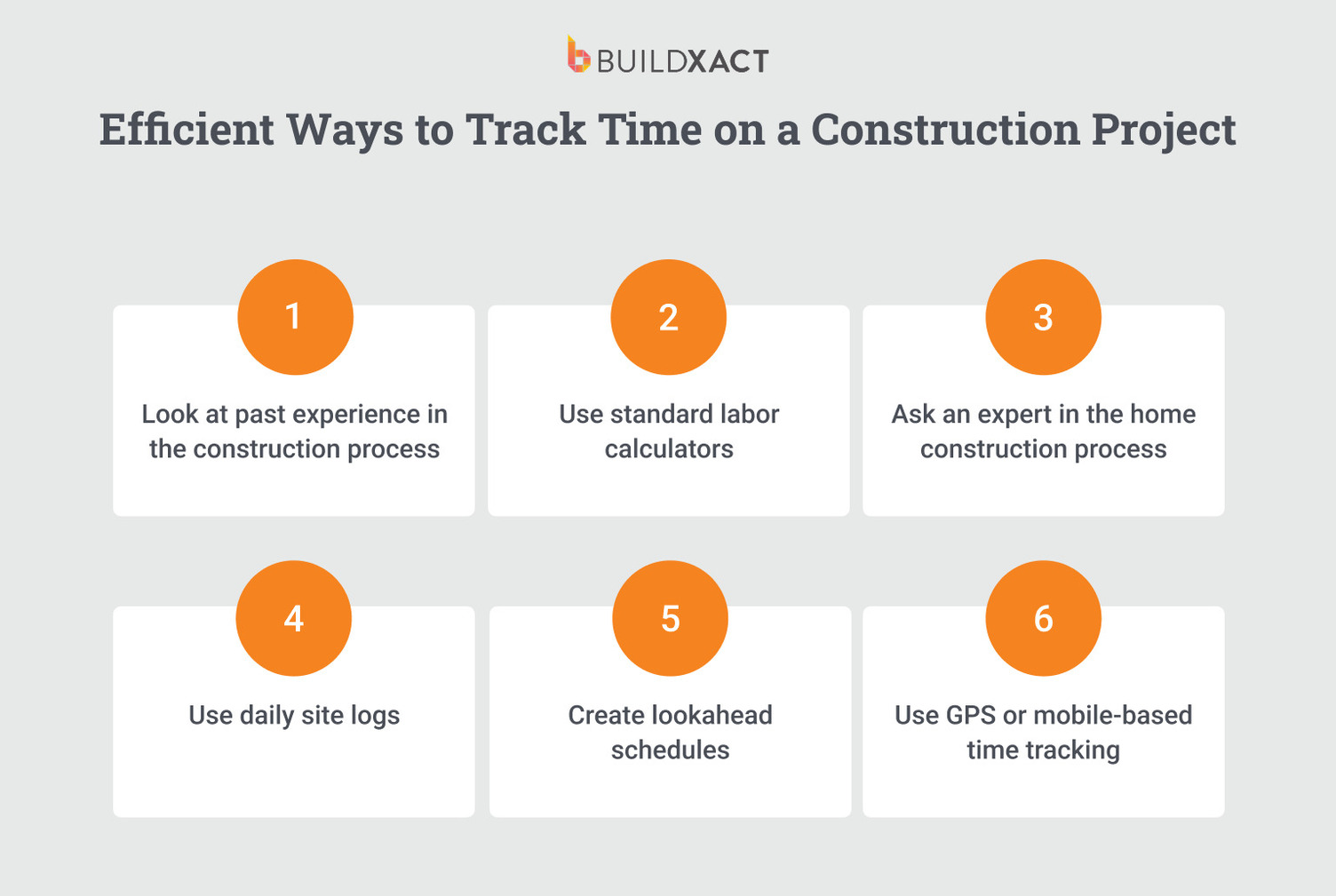
There’s more than one way to figure out how long a job will run. Here are some tools and approaches builders use to estimate construction time.
Past experience in the construction process
The best way to estimate the time to complete a project is to base it on a similar floor plan. The data will be more accurate than labor calculators or other estimation methods since the data is based on real activities.
You might have to do some calculations when comparing your home-building timeline. For example, if laying 100 linear feet of a 5-foot-tall brick wall takes your crew 40 hours, then you can estimate that it will take your crew 20 hours to lay 50 linear feet of a similar brick wall.
The accuracy of your estimate will depend on the accuracy of the records of actual construction from past projects. The more detailed your record-keeping, the easier it will be to calculate a reliable estimate. It pays to keep detailed records, especially when tracking productivity.
Standard labor calculators
If you are a new company or don’t have prior experience estimating how long a project will take, you can refer to standard labor calculators to get an idea. There are many labor calculators available, some provided by professional organizations such as RSMeans. RSMeans gathers cost and duration information on projects around the United States and publishes it as a cost index that many contractors rely on when estimating the cost to build a house.
You can use standard labor calculators to estimate the amount of time it might take for a full or partial project. For example, you can get an approximate time estimation for a two-story commercial office building, or you can find out how long it will take a plumber to lay 100 feet of ¾ inch copper piping. Using this information, you can determine how long a project will take by breaking it up into smaller sections and scopes within the home construction process.
It’s important to note that standard labor calculators may not reflect durations and costs in the region where the project is located. You may need to add or subtract time to reflect a more accurate estimate.
Ask an expert in the home construction process
A subcontractor can provide the average time for a particular task. Once the subcontractors are selected, the general contractor asks them to provide a schedule for their work, and then consolidates all the subcontractors’ schedules.
Because subcontractors handle such a large portion of each phase, their input is essential when putting together a realistic construction timeline.
Daily site logs
Daily logs are simple but powerful construction reporting tools. Rather than trying to remember what happened on which day, you record in real time how long each phase takes under real building conditions. Daily site logs cover:
- Which trades were on-site
- What tasks were completed
- Weather conditions
- Delays or disruptions
- Inspections or deliveries
- Photos of progress
Buildxact’s Daily Logs feature lets you add posts by date, attach images, backdate entries if needed, and search historically by keyword. You can quickly jump to a calendar view to see when something occurred, search for past delays, and share updates directly with clients via the Client Portal.
Over time, this creates a reliable record of how long phases really take — not just how long they were meant to take.
Time tracking by phase or cost code
Instead of just tracking total job duration, break time down into phases.
- Site prep
- Slab
- Framing
- Roofing
- Lock-up
- Fit-out
For example, if electrical rough-in consistently runs two days longer than estimated across multiple builds, you can adjust future construction time estimates based on this pattern you’ve identified. This is how tracking construction time feeds directly into better construction time estimation on the next job.
Lookahead schedules
A master schedule is important for the big picture, but short-term lookahead schedules are where time management gets practical.
Short-term planning (typically 2–4 weeks ahead) helps you:
- Confirm upcoming trade start dates
- Check that materials are ordered
- Book inspections in advance
- Identify clashes before they happen
For example, if the slab pour is delayed, your lookahead schedule forces you to adjust framing, plumbing, and electrical work before the trades show up unnecessarily. This makes construction time management proactive instead of reactive.
GPS or mobile-based time tracking
With mobile apps, crews can clock in and out by task or project. You can capture real hours worked on each phase and identify overtime trends. You can then assess whether your productivity assumptions are correct and set more accurate production rates going forward.
You’ve Tracked Construction Time — Now What?
Tracking construction time only matters if you use it to make better decisions. When time tracking is tied to the schedule, not just timesheets, it becomes a practical tool for keeping projects moving.

Flagging delays early in the build timeline
When you compare planned time vs actual time weekly, you don’t have to wait until the end of the job to discover you’re behind. If roofing is scheduled for five days and it’s still not complete on day seven, that’s your cue to adjust the next trades immediately. You can reshuffle tasks, extend buffers, or bring in extra help before the delay pushes your completion date out.
Understanding whether delays are one-offs or recurring
Not every delay means your estimate was wrong. Sometimes it’s weather, late materials, or a change order. But when the same phase consistently runs longer across multiple jobs, that’s a pattern, not bad luck. And your scheduling assumptions need to be adjusted.
Feeding real data back into future schedules
The biggest long-term benefit of construction time tracking is better planning. Instead of relying on guesswork or industry averages, actual time data becomes your reference for future projects. Over time, your schedule templates get tighter, your quotes become more accurate, and your projects run with fewer surprises.
Common Causes of Home Build Delays
Even the most complete project schedule can be affected by several outside factors.

Material delays
Material delays are a hot topic in construction right now. There is a domino effect when materials aren’t on-site, causing delays in all phases of the building process.
Weather
Weather conditions like heavy rain, extreme heat, or freezing temperatures can slow crews down or stop work altogether. In some cases, workers may need to repair areas damaged by the weather, which adds more time to the schedule. Weather isn’t preventable, but you should still anticipate its impact.
Labor shortages
Labor shortages or unavailability affect progress on a construction project. When a contractor doesn’t send enough workers to the job site to complete the work needed, everything gets delayed. A subcontractor may need to send workers to another project to combat delays there, thus causing more issues on your project. It can be a vicious cycle.
Change orders
When a client approves a change order, the schedule should be updated right away. Extra work takes extra time, and if you don’t adjust the plan, it can push everything else back. Even small changes can affect the overall completion date if they’re not built properly into the timeline.
While these types of delays can be managed to some extent, many are beyond a contractor’s control. This is why schedules always change. As long as the completion date stays the same, small delays are usually tolerated.
But when a delay affects the critical path of the project or the path of tasks required to meet the completion deadline, then problems can occur. Contracts may include liquidated damages clauses if the completion date is not met, which is why contractors should include as much wiggle room as possible in their schedules to accommodate any unforeseen delays.
Managing Construction Time As a System
Good construction time management isn’t about building the perfect schedule once and hoping it sticks. Schedules should be living documents, not static files published once and forgotten. And because no project runs in a vacuum, properly tracking time gives you more control over your entire job.
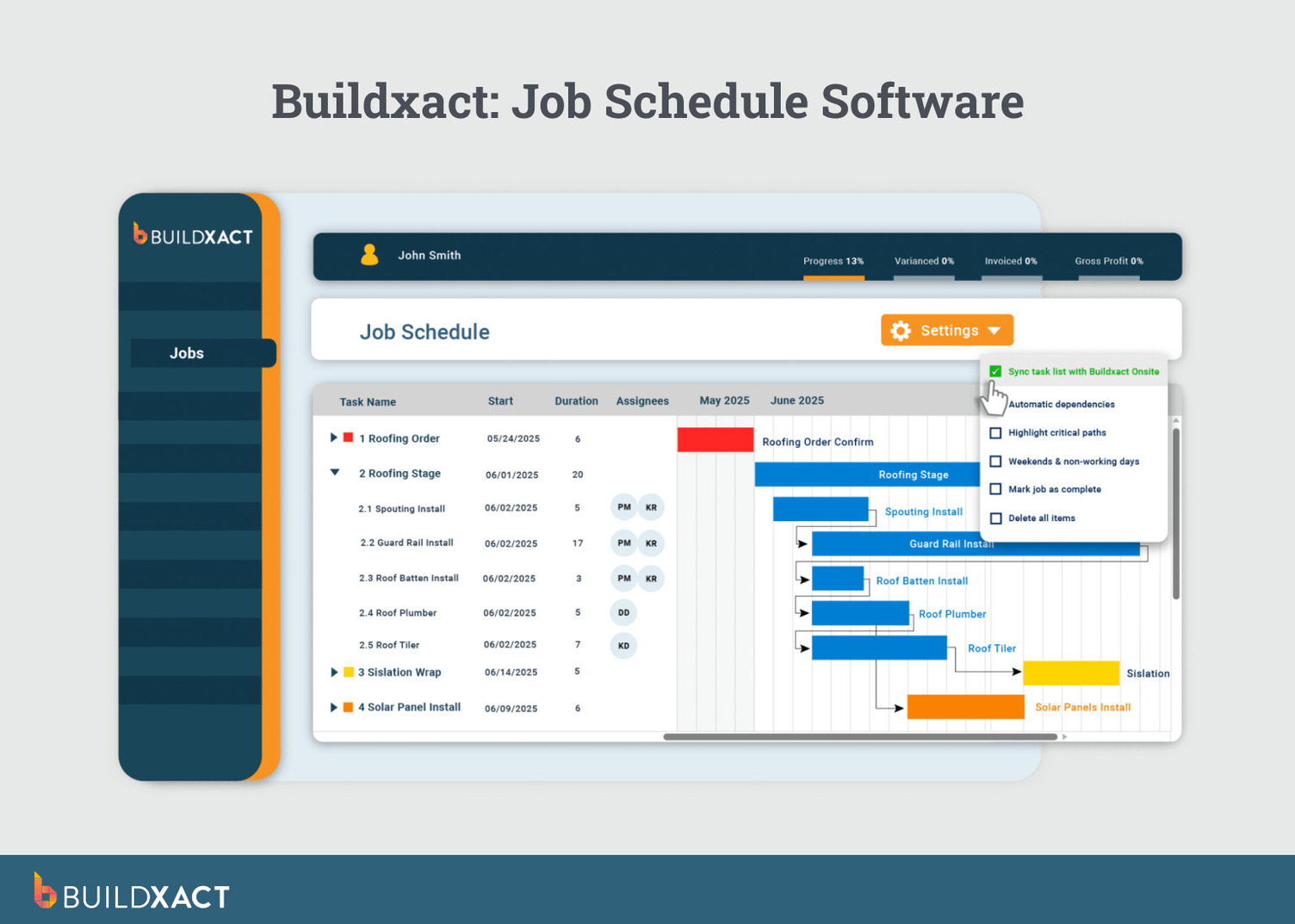
With Buildxact, your estimating, scheduling, and job tracking all work off the same data. So when time shifts, you see the impact straight away. Your projects are less based on guesswork, but a reliable system.
Book a demo to see how Buildxact can transform your residential construction business, or get started with a 14-day free trial.