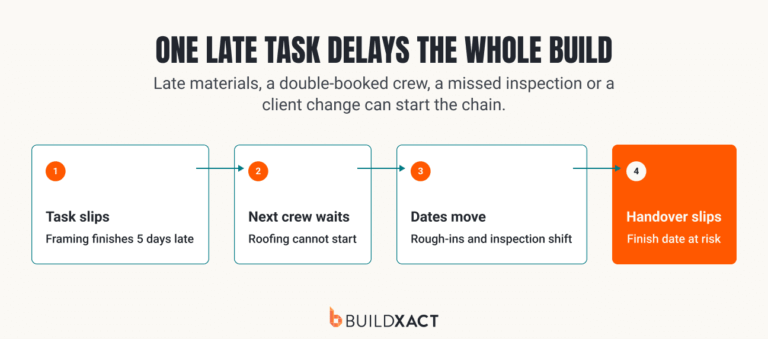


You bid a job at an 11% margin but closed it out at 5.5%, and there’s no single line on the job report showing where the other 5 points went.
Most builders look at labor here as the likely cause, but that’s the cost you’re already watching closely during the build, so it’s rarely where margin is actually lost.
The costs that erode margin are the ones without their own line: rework, scope creep, material waste, and estimating error.
In this article, we’ll explore those four key causes of cost overruns on residential construction projects, explain where each leak hides in the numbers, and explain how to prevent it in the first place.
Key Takeaways
- Labor is rarely the main cause of cost overruns on residential jobs. It’s already closely tracked and estimated from known crew rates.
- The real leaks are rework, scope creep, material waste, and estimating error, and these costs don’t get their own line on the job report.
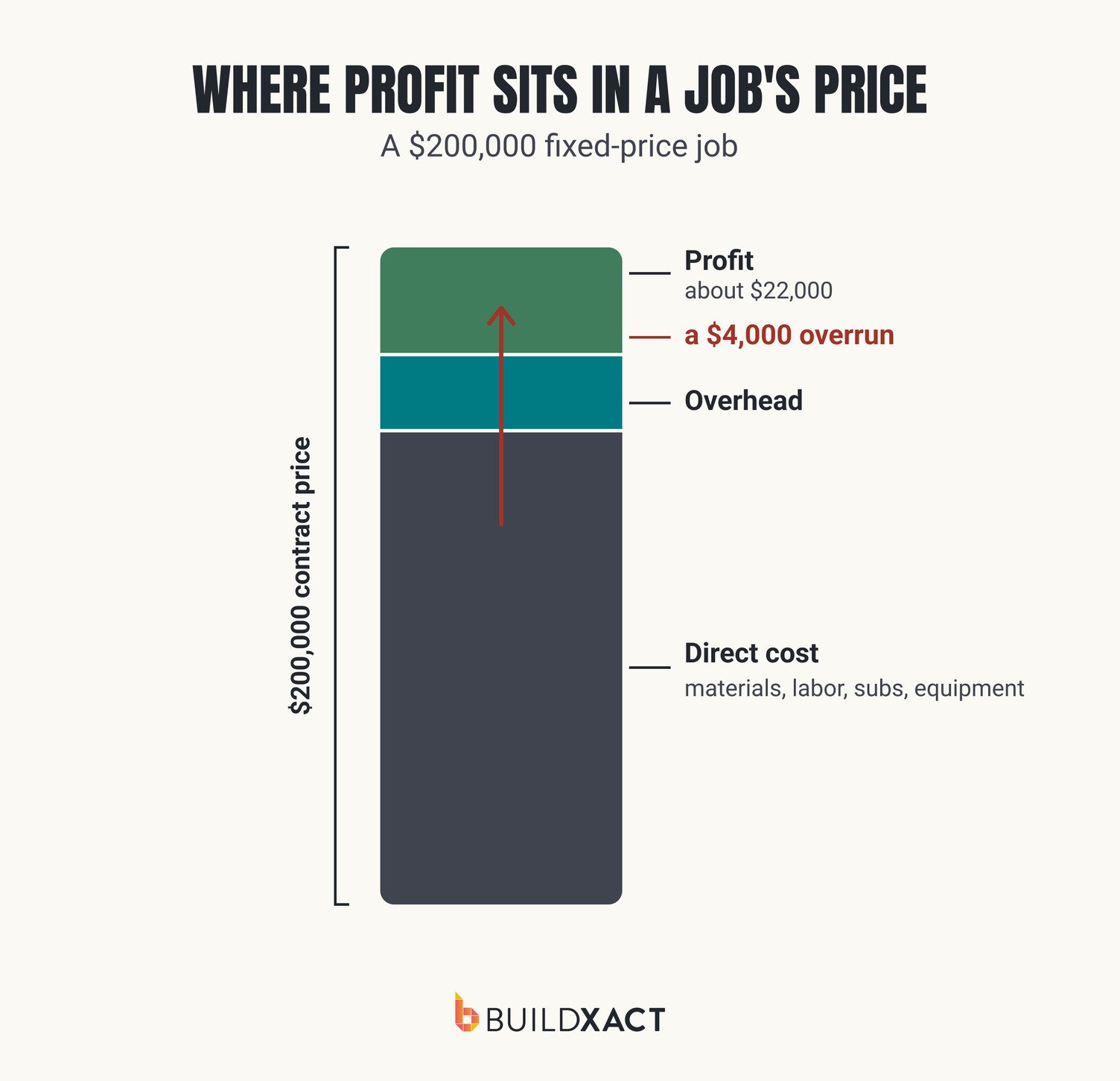
- Small overruns do outsized damage to margin. A $4,000 miss on a $200,000 job is only 2% of the contract price, but it’s 18% of an $22,000 profit.
- Each leak hides in a different place: rework inside labor hours, scope creep in unpriced on-site changes, waste in material bought past the takeoff, and estimating errors in pricing that don’t get refreshed.
- Every leak can be caught before close-out by checking it against the estimate while the job is running, pricing change orders, tracking material against takeoff, and logging rework against its cause.
What Is a Cost Overrun and How Do You Calculate It?
A cost overrun is the amount by which the final job cost exceeds the estimated cost the builder bid.
There are two ways to calculate it, depending on whether you want to know the dollar amount by which you ran over budget, or the percentage compared to estimated costs:
- Overrun amount = actual cost − estimated cost
- Overrun percentage = (overrun amount ÷ estimated cost) × 100
This is crucial for residential builders to understand, as it has a direct (and outsized) impact on margins.
Consider a $200,000 job bid at 11%. Most of the price of this job goes to direct costs (materials, labor, subcontractors, and equipment). Profit is the thin layer on top, about $22,000.
Take one leak on that job: a $6,000 cost you didn’t bid.
It’s only 3% of the $200,000 price, but it’s 27% of your $22,000 profit. That’s what makes small overruns dangerous.
Calculating cost overrun tells you by how much you went over budget, but it doesn’t tell you where the overrun actually came from.
Where Do Cost Overruns Actually Come From?
Residential builders often look to labor when trying to diagnose why a job ran over.
The thing is, labor is the line tracked most closely on every job, and it’s estimated from known crew rates, so it rarely varies enough to be the cause behind a 5% margin hit.
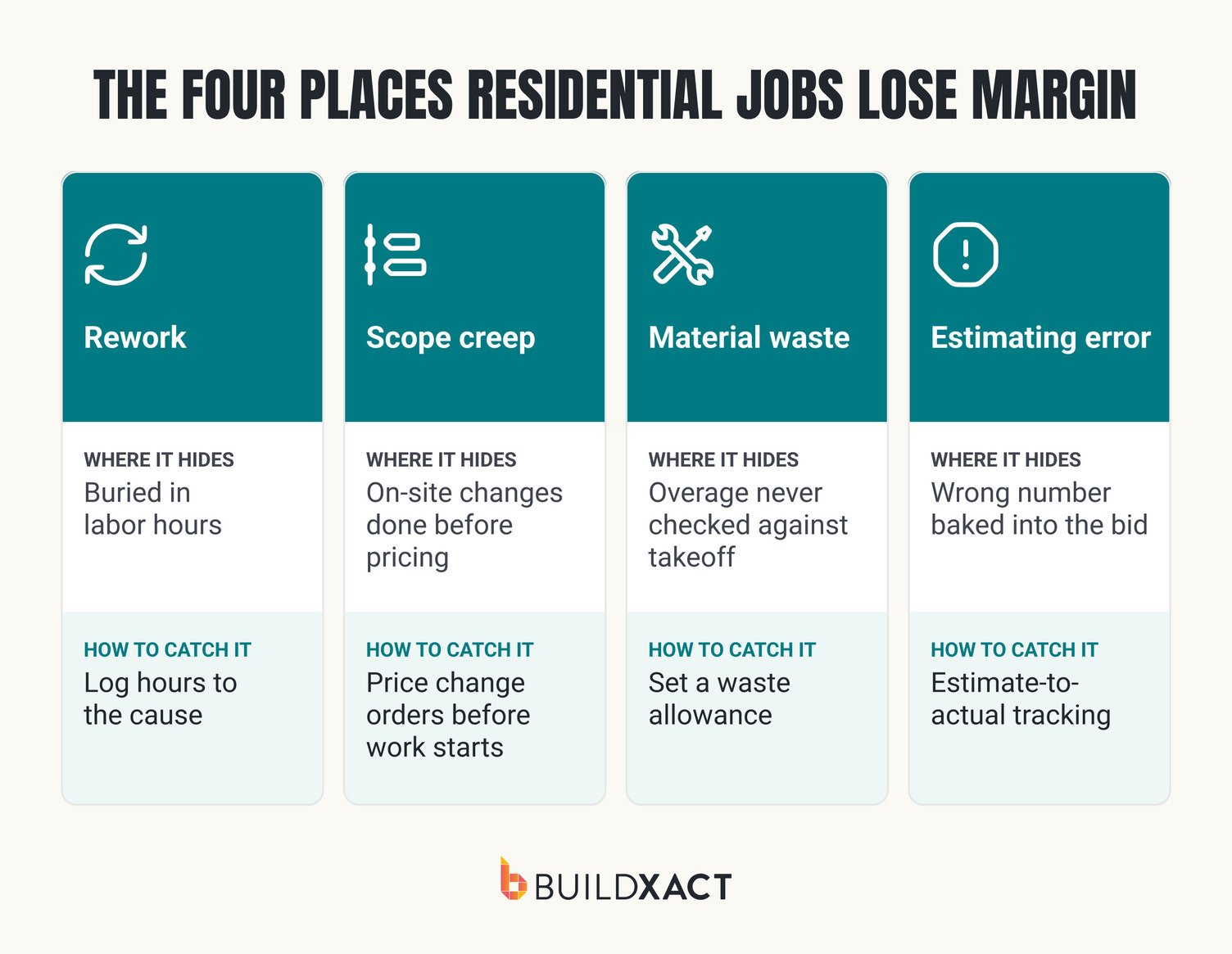
The four costs below each hide inside other lines or never get measured against the estimate at all, making them the real cause of many cost overruns.
| Cause | Where it hides | How to catch it |
| Rework | Absorbed into labor hours and written off as “finishing” | Log the hours against the cause, not the task |
| Scope creep | On-site changes done before they are priced | Price every change order before work starts |
| Material waste | Overage never compared back to takeoff quantities | Set a waste allowance and use cost tracking software to monitor actuals against takeoff |
| Estimating error | Pricing or quantity mistakes that only show once the job runs | Estimate-to-actual tracking that flags the variance early |
How much does rework cost a residential builder?
According to the Construction Industry Institute’s A Guide to Construction Rework Reduction report, rework typically amounts to 2% to 20% of the contract amount. Design changes, errors, and omissions make up the bulk of it, adding up to 79% of deviation cost.
That’s a huge problem when industry margins average around 3–7%. A 5% rework hit on a job bid at 11% margin takes nearly half the profit.
Rework pushes the labor line over its estimate, but without its own line, all you see is that labor ran high, not that a chunk of it was fixing a mistake that was never bid.
On the $200,000 job we examined above, a wall rebuilt after a framing error added $4,000 in labor and material, and none of that was planned for in the original estimate. That $4,000 is 2% of the job but 18% of the $22,000 profit, nearly a fifth of the margin spent fixing one mistake.
How does scope creep eat job margin?
Scope creep is work added after the bid that doesn’t get added as a change order and built into the final price.
Often that comes from an event like a client asking for a change on site, and the crew just completing it, meaning the change gets absorbed under labor and materials and never priced in.
Each unpriced change spends direct cost against a fixed contract value, so the margin percentage falls with every one.
Say the same job sees a handful of small on-site changes waved through with no change order, because none of them look like they’d cost anything: a door moved before framing, an outlet relocated, a window trimmed to fit a different unit
Each one means adjusting the plan and rescheduling labor already in progress, but since the end result looks the same as what was bid, none of it gets priced. Those changes could represent $2,500 in additional work, and if none of it gets billed, it comes straight out of your profit margin.
The solution here is to make it mandatory to price and get sign-off on every change order before the work starts, even if it means a slight setback. This means any added scope changes the final price and gets its own margin added on top.
How much does material waste add to job cost?
Waste is the difference between the material bought and the material the takeoff called for.
Say your takeoff calls for 40 sheets of drywall. You ended up buying 48 because some got cut wrong, a few got damaged, and you grabbed extra to be safe. If nobody ever puts those two numbers side by side, the 8 extra sheets just get paid for and forgotten, and the cost of that waste comes straight out of your margin.
On the $200,000 residential job, $1,500 in drywall waste would take another 7% of the $22,000 profit built into the bid.
A takeoff sets the quantity the planned job needs, but not all jobs go according to plan. A waste allowance built into the estimate is what protects margin here. Any cost control strategies employed to reduce waste either increase profit or can be passed on to the customer, buying you goodwill.
How do estimating errors turn into overruns?
An estimating error is a pricing or quantity mistake baked into the bid. You generally don’t catch these until the actual cost exceeds the estimate, and there’s no clear change or waste that accounts for it.
Two patterns cause most of this error.
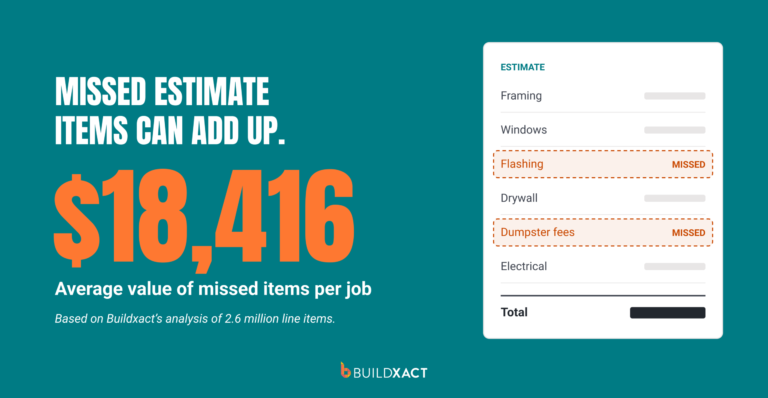
- Missed line items are the most common, averaging $18,416 per job among builders who tracked them (see our guide to common estimating mistakes for how to catch them before the bid goes out).
- The other is a stale estimate, pricing that was never refreshed against current material and labor rates once the job was approved, and then carries outdated numbers into the contract (covered in depth in our cost forecasting article).
Say the same job has a subcontractor line underpriced by $3,000 at bid, a mistake that only shows up when the invoice comes in higher than the estimate. That’s 14% of the $22,000 profit, lost before the first day of work because the number was wrong from the start.
How Do You Catch Overruns While the Job Is Running?
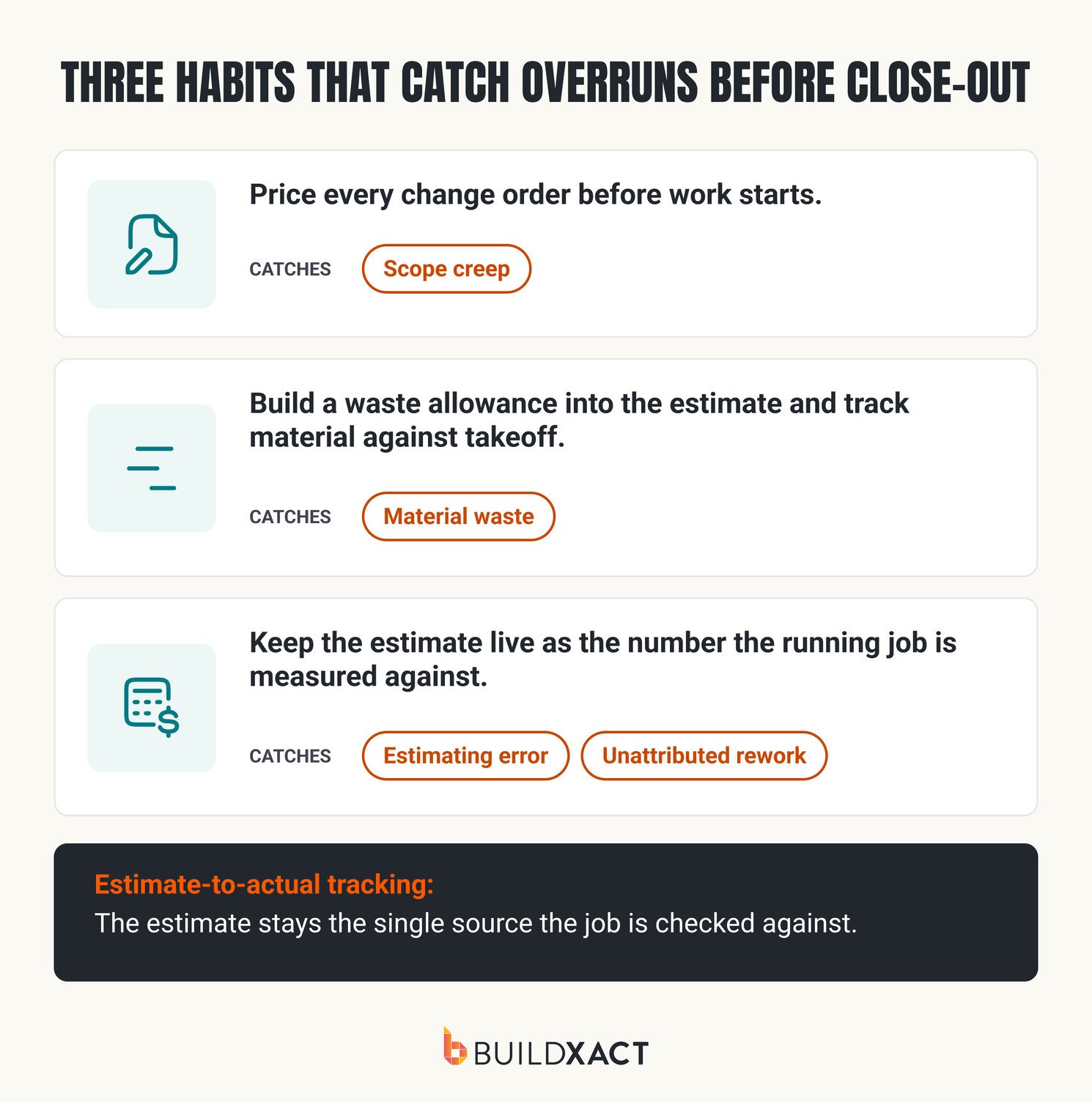
Each leak outlined above can be caught with the same cost management strategy: checking costs against the estimate while the job is still active.
Here’s what that looks like in practice:
- Price every change order before the work starts, so added scope carries its own margin
- Build a waste allowance into the estimate and track material bought against takeoff quantities, so overages are immediately obvious
- Log rework hours against the cause, not the task, so a mistake being fixed doesn’t just read as “labor ran high”
- Keep the estimate live as the reference the job is measured against, so a subcontractor line or missed item shows as a variance the moment actual cost passes it
Add up what the four leaks took from this job: $4,000 in rework, $2,500 in unpriced scope, $1,500 in material over the takeoff, and $3,000 in an underpriced sub line.
That’s $11,000 off a job bid to make $22,000, meaning the job that was meant to make 11% margin came out at just 5.5%. The thing is, every one of those margin leaks was priceable or trackable against the estimate before close-out, which would have retained the original 11% margin.
Estimate-to-actual tracking is the mechanism underneath all four: the estimate stays the one number the running job gets checked against, so a leak shows up as a variance while there’s still job left to adjust it on.
Buildxact users complete their first estimate 7x faster than manual methods, time that goes back into keeping that estimate live instead of chasing a close-out report for answers.
Stop Cost Overruns Before They Eat Your Margin
Cost overruns don’t appear as a separate line item on the final cost report.
They’re hidden in labor costs, changes that didn’t go through a formal change order process, more material bought than the takeoff called for, or a subcontractor line that was wrong from the start.
The best fix is to keep the estimate live as the number the job gets checked against while it’s still running, so a leak shows up as a variance you can act on instead while you still have time.
Buildxact’s estimate-to-actual tracking software gives you one place to price change orders, track material against takeoff, and see a job’s real margin while there’s still time to protect it.
Book a demo to learn how Buildxact can help you keep costs under control.
FAQ
What helps prevent budget overruns in residential projects?
Three practices help prevent budget overruns in residential projects:
- Price every change order before work starts
- Build a waste allowance into the estimate and track material bought against takeoff quantities
- Keep estimate-to-actual tracking running while the job is live
How do you calculate construction overhead and profit?
Overhead rate = annual overhead costs ÷ annual direct job costs, expressed as a percentage. If overhead runs $120,000 a year against $800,000 in direct job costs, that’s a 15% overhead rate
Profit is added on top as a target margin, so a bid at $100,000 direct cost with 15% overhead and 10% profit prices out around $132,500.
Is labor the main cause of cost overruns on residential jobs?
Rarely. Labor is already estimated from known crew rates and watched on the schedule, so it seldom drifts far enough to explain a lost margin on its own. Rework, scope creep, material waste, and estimating error are the costs more likely to go untracked.