A construction quality control plan is the written version of your quality standards. It sets out what gets checked, at what stage, and who signs off before the next trade starts work.
All too often, that standard isn’t written down anywhere.
It lives in your head, or maybe in scattered site notes and texts, and it gets applied when you walk the job. That works fine on one job, but falls apart when you start running multiple jobs at once or a sub comes in for a single task, and nobody is there to check the work against it.
The plumber sets a drain line at the wrong fall, no one checks it before the slab goes down, and the city inspector fails it after the concrete is poured. Now you are breaking up a finished slab to fix a grade that a two-minute check would have caught.
A construction quality control plan keeps that standard in force when you are not on-site to enforce it yourself.
This article covers the components of a plan, a template you can adapt, and how to run the whole thing from your phone without setting aside office time to maintain it.
Key Takeaways
- A quality control plan is the written version of your quality standards. It spells out what needs to be checked, at what stage, and who signs off on it.
- Six things belong in a solid plan: your standards, your inspection checkpoints, who’s responsible for what, pass/fail criteria, how you document results, and how you handle anything that doesn’t pass.
- Without a written plan, defects tend to get caught late, and that regularly turns into rework and change orders eating into your margin.
- A written plan also gives you something concrete to show a client, so they can see what has been checked and against what standard.
- You can run this digitally now instead of on paper. Buildxact Onsite lets the crew log checks and photos from the job site as they happen.
Why a written construction quality control plan is more than a box-checking exercise
A QCP is not another box-checking exercise or piece of paperwork to be quickly filled out at the end of the day.
It’s a written plan that replaces quality standards that live only in one person’s head with something the whole crew can follow without them on-site.
Without a written plan, defects get caught late.
A framing issue or an out-of-spec rough-in that isn’t caught before the next trade builds over it (drywall, insulation, siding) turns into a tear-out instead of a five-minute fix, which is what drives the rework and change orders that eat into your margin.
That has a direct cost for builders: Benchmarking data from The Construction Industry Institute puts field rework at more than 3% of construction-phase cost on the projects it studies
The QCP also gives a builder something concrete to show a client (what’s being checked, when, and against what standard), and creates a written record that protects them if a client disputes the quality of finished work months after handover.
Increasingly, this plan lives digitally rather than on paper, with checklists and sign-offs completed on-site from a phone (e.g. Buildxact Onsite) instead of filed away back at the office. A digital record also timestamps when something was checked, which matters if a defect dispute comes down to when an issue was caught versus when it was covered up by later work.
6 key components of a construction quality control plan
Every quality control plan is built from the same six parts. Whether you use the template below or build your own, these are the components that make a plan work on-site instead of sitting in a drawer.
- Standards and specifications: The benchmarks the work must meet, drawn from the contract, local building codes, and industry standards
- Inspection and test checkpoints: What gets checked, at what stage of the build, and how. Safety inspections and risk assessments also sit here.
- Roles and responsibilities: Who inspects, who can stop non-conforming work, who signs off. For example, safety issues identified during a routine inspection are raised to the person responsible for on-site management.
- Acceptance criteria: The pass or fail measure for each checkpoint, so it isn’t left to judgment.
- Documentation and records: How results, photos, and approvals get captured and stored.
- Deficiency handling: How defects get logged, corrected, and re-checked, usually through a punch list.
Free construction quality control plan template
This QCP template turns the six components discussed above into a working checklist. Each row is an inspection checkpoint tied to a stage of the build, from site prep through to the final walkthrough.
A few of the rows are marked as hold points.
These are the checks where work stops until the item is signed off, because the next stage is about to cover it: the pour, the rough-ins before drywall, waterproofing.
The stages come pre-filled for a typical residential build, so you’ll just need to adapt the rows to your own scope rather than starting from a blank sheet.
One thing this template keeps separate is your quality assurance standard and the local code inspection. The government inspection checks minimum code. This plan is your own walk-through on top of that, against the contract spec and your own standard of finish.
Download the free construction quality control plan template.
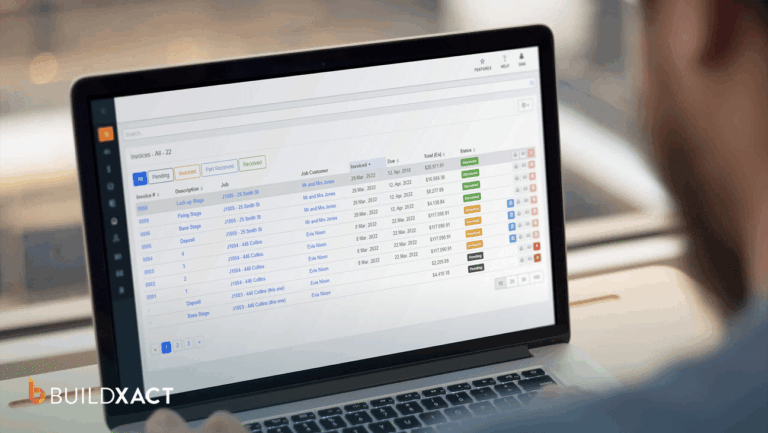
This is where a plan stops being a document and becomes something the crew runs day to day. Buildxact Onsite lets crew members log daily progress and site photos straight from a phone, syncing back to your Buildxact account automatically.
The inspection checkpoints in your plan get carried out on-site, in a dated log tied to the stage of the build, made as the work happens rather than reconstructed later. That same log is where the documentation component lives. Photos and notes captured in the moment become the stored record, so if a question comes up months after handover you have the date and the evidence rather than someone’s memory of it.
How Buildxact’s construction management software helps
A quality control plan only pays off if the checks actually happen and get recorded.
Mobile apps like Buildxact Onsite allow crews to log each check and the photos to back it up from their phone as they work. From there, the proof syncs to your account, so the plan runs on-site instead of sitting in a folder.
That record is also what protects your margin.
Builders who run post-project audits on their jobs land around 7% net profit, higher than the industry median. The plan is how you get there: catching a defect at the checkpoint costs you a few minutes, but catching it in rework costs you the margin on the job.